
Designed for
by humans
by humans
{ What has changed with the arrival of AI, and what hasn’t }
By Rubén

Sánchez
Founder & Design Director, Dgrees Studio
The backstory
When I was a kid, some summers I’d go with my father to work. He was a marble craftsman.

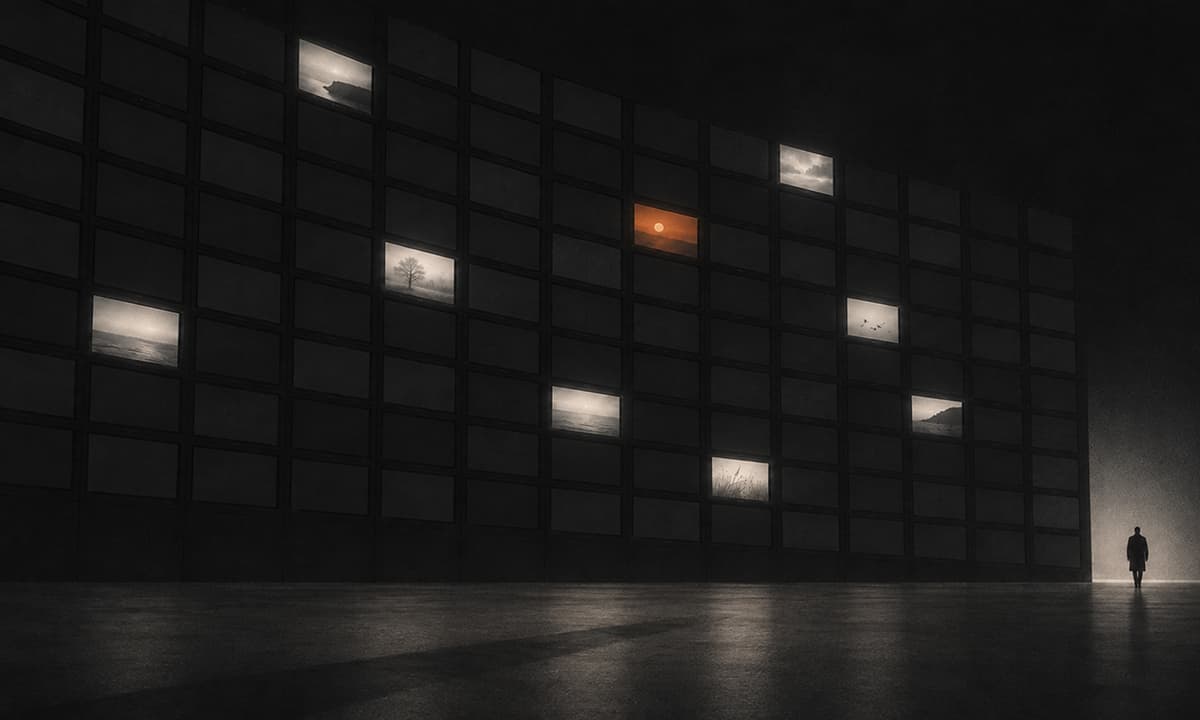
The workshop where he worked was full of huge stone slabs, hundreds of them, in every tone, colour and texture. I’d chase him between them and watch him touch them, run his hands over them, study them one by one — and set them aside. To me they were all breathtakingly beautiful, even raw, unpolished. But he kept looking, until suddenly he stopped and chose one. One among hundreds. The one that would serve the piece he had in mind.
I didn’t know it then, but I was watching judgment at work. Not the skill to make — which he had too — but the skill to choose.
Today, forty years later, my work as a designer comes down to the same thing.
I’ve been designing for over twenty-five years, and in all that time one phrase has echoed through our sector more than any other: human-centred design. Designing for people. Today, however, a different expression is being used and repeated everywhere: designed by humans.
It’s not a contradiction. It’s a shift in focus. What used to matter was who you design for. Now it also matters who designs. And whether you’ve been at this for twenty-five years or started yesterday, that affects you directly.
With the arrival of AI, producing has become trivial. Today anyone can generate several design proposals in an afternoon, and almost all of them can be correct — even attractive, original or creative. Like those slabs: all beautiful, all apparently valid. But this, far from being a competitive advantage, is a problem: without proper direction, these options are soulless proposals whose only value is immediacy. And when everyone can produce something like that, it becomes mediocre.
What hasn’t become trivial — what no tool can do — is what my father did among the slabs: deciding which one serves, and why.
At Dgrees, judgment isn’t a trend or a passing slogan: it’s how we’ve worked for over ten years. But now it matters more than ever.
1. The diagnosis
What’s happening with AI

1.1
The single-prompt myth
The internet is full of a very specific promise: entire projects solved “with a single prompt”. The reality behind it is usually less magical. There are already tools dedicated to reverse-engineering any published website — you feed them a URL and they hand you back the prompt to replicate it. They’ve multiplied so fast that some have become a viral phenomenon in a matter of days. What that prompt doesn’t contain is everything else: the research, the decisions, the iterations, the discards. All the work someone did beforehand to reach the result that is now replicated in minutes.
The problem isn’t the trick: it’s the uncertainty it creates. Many clients now approach a project drawn by that promise of immediacy and low cost, convinced that designing and developing means describing. And it’s not their fault — it’s what they’re being told.
1.2
Access to the resource, not the knowledge
Let’s acknowledge it without fear: AI has put within reach of people with no technical knowledge the ability to build things that three years ago required a team of experts. Experts who, most likely, invested years of their careers to get there. It’s one of the greatest advances we’ve seen — and the web is filling up with resources born from all this, ready to copy and paste.
This opens an enormous door. But it’s worth understanding to what: to the resource, not to the knowledge. It reminds me of the early days of WordPress, when everyone was installing plugins of every kind on their sites — we all know how that usually ended. It’s a fact that access to these resources enriches portfolios and multiplies competition.
The danger ahead, in my experience, is a different one: getting comfortable. And not simply because AI can do the less critical tasks for you — we all do that — but because, in the race to be competitive, you end up delegating to the tool the ones that do matter too. And cutting exactly the time you shouldn’t cut: the time to iterate, compare and make well-founded decisions. The shortcut gives you the resource today and costs you your judgment tomorrow.
1.3
The saving that costs you
Picture an increasingly common scenario: someone with no experience relies entirely on an AI. The project ships, goes live, works. And one day that tool is no longer there — it changes, gets expensive, disappears. This has already been measured: in a recent study, the vast majority of those who built with unrestricted AI were unable to maintain their own project once the tool was gone. The technical debt of all this already has a literature of its own.
Let’s not misread this: AI is very far from being the problem. But in inexperienced hands it becomes uncontrollable — a blank canvas covered in scribbles. A project doesn’t end when it’s published; that’s where it continues. Someone has to evolve it, fix it, make it grow when the business changes. And a prompt doesn’t answer emails, or make decisions.
2. The method
How we work with it

2.1
Understand before moving forward
Our way of working with AI comes down to one word: question. To understand why it matters so much, it helps to grasp first how fast all of this happens: a conversational AI generates its answers faster than anyone can read them. A single question gets a reply in seconds — a specific piece of data, a copy line, a business-focused direction, a design proposal. The dirty work is already done: it has saved you hours, even days.
But all that knowledge it puts within your reach in the form of an answer needs to be agreed on, measured and questioned. It can never be a copy and paste. A tool always proposes something — that’s its job. Ours is to question what it proposes, because AI can’t tell a good brief from a wrong one: if the direction is off, it executes it just as fast and just as well. It amplifies whatever you give it — the right call and the mistake. And a bad decision in the early stages carries all the way through to the last pixel.
That’s why order matters more than ever. First the questions: what does this business need, who is its audience, what must the project achieve. Then the tools — as many as it takes. There are two ways to use AI: that of someone who simply applies whatever the AI says, and that of someone who uses it to test what they already know. At Dgrees we don’t move forward until we’ve made the answer our own. AI hasn’t changed that principle. It has made it urgent.
2.2
The visual can’t be improvised
With AI there’s a line we don’t cross: visual direction and its execution are human. Always. Not out of romanticism, but because that’s where it’s decided whether a project has brand personality or is just one more among the infinite ones anyone can generate today.
For years, part of the sector criticised our work for giving so much weight to aesthetics — we were the ones who “make pretty websites”. Today many of those same studios, with aesthetics handed to them by AI, flood their projects with effects and motion with no brand reason behind them. They’ve travelled the opposite path: they’ve reached the visual layer without judgment, damaging the functional one along the way — which was precisely the one they handled best. Aesthetics were never the problem. Improvising them was.
When working with AI on the visual side, you don’t ask it to decide: you ask it to help build what has already been decided. Thinking, exploring, comparing and deciding takes time — and that time is what separates a memorable project from just another one. AI shortens production; we use it to devote that time to what truly matters. It’s a human who makes every decision.
Judgment is trained.
My father wasn’t born knowing how to choose one slab among hundreds: he spent a lifetime touching them.
My father wasn’t born knowing how to choose one slab among hundreds: he spent a lifetime touching them.
3. The consequence
How it affects us
3.1
This is already happening
None of the above is a theory we observe from the outside. We’re living it: over the past year we’ve received more project enquiries than ever — and it has never been so hard for a project to actually materialise. Conversations that fizzle out, emails that stop getting replies, proposals that fall through the moment work done properly costs what it costs. The promise of immediacy is, one way or another, behind almost all of them.
I don’t say this as a complaint — it affects us too, but we’ve spent over ten years learning to explain the value of what we do. I say it because it points to something bigger. The market is splitting in two: there are studios closing, and others that have rushed to compete on price with those they’ll never be able to compete with. The data already confirms it: since the arrival of generative AI, demand for freelance work in writing, coding and design fell by 17 % to 21 % — and the hardest hit were the most experienced profiles, not the cheapest ones. It’s part of the job, and it’s nothing new. But there’s one consequence that is.
If this dynamic is squeezing established studios, what is it doing to those just starting out, to those who don’t yet have a track record to show? Studios are where the craft is learned — where someone starting out watches those with years of experience discard, correct and decide. If that chain breaks, the problem is no longer the studios’. It’s the whole sector’s.
The verdict
Judgment
can’t be
improvised
can’t be
improvised
AI has democratised design and, with it, the sector has filled up with proposals. That’s why today the difference is made by credibility and judgment — and neither is built overnight, but over time.

Marble chessboard, handmade by Juan Antonio Sánchez Torres, my father. It was the last piece he ever made.
Those who stand out in this era won’t be the ones who produce the most, but the most demanding critics: those who explore more possibilities and have the judgment to identify the one that’s truly worth it. As in chess: it’s not the fastest player who wins, but the one who makes the best decision at every move and anticipates what comes next. That’s good news for anyone starting out — nobody is born with this. And a warning for those who’ve been at it for years: judgment that isn’t exercised is also lost.
At Dgrees we’ve spent over ten years training exactly that. Behind any work that lasts there are years of decisions defended, of discards, of projects that turned out well as the natural consequence of doing things without shortcuts.
Our track record is something an AI can’t take from us. It can build anything you’re able to describe, but for now it doesn’t make a decision it cares about. It tells right from wrong — better than anyone — but it struggles to separate right from extraordinary. And that space — the space of taste, of discernment, of judgment — is ours. The people who make up this studio.
That’s why everything that comes out of Dgrees will continue to be, quite literally, designed by humans.
 Digital brand adaptation
 Strategy Content